Past Continuous Tense|Definition, rules, Formula, Examples

Past Continuous Tense is used to express the actions of the past that would be going on during the past period and was not completed during a specific period of past time. It means that Past Continuous Tense indicates progressive actions of the past time. For example:
- I was speaking.
- You were speaking.
- He was speaking.
- We were speaking.
- They were speaking.
- They were watch television all evening.
- It was getting dark, and darker with time.
- The light went out while she was cooking.
- When I saw her, she was quite healthy.
Helping Verbs of Past Continuous tense
Past Continuous Tense expresses actions of the past that would be in progression in the past. To express the continuous actions of the past, Past Continuous Tense use “was/were”, as helping verbs. So, Past Continuous Tense has only two helping verbs as compared to Present Continuous Tense which has three “is/are/am”.
“Was” As Helping Verb in Past Continuous Tense
“Was” is used as a helping verb in Past Continuous Tense with singular number nouns, and with the following singular pronouns:
- I
- He
- She
- It

“Were” As Helping Verb in Past Continuous Tense
“Were” is used as a helping verb in Past Continuous Tense with plural number nouns, and with the following plural pronouns:
- You
- WE
- They

Sentence Structure of Past Continuous Tense
Assertive, Negative, Interrogative, and Negative-Interrogative Sentences of Past Continuous Tense use “was/were” as helping verbs with 1st form of the verb and the addition of “ing”, to express the continuous actions of the past time.
Assertive Sentence Structure of Past Continuous Tense
Assertive Sentences or simple declarative sentences of Past Continuous Tense use “was” as a helping verb with singular number nouns and singular pronouns. The Assertive Sentence Structure of Past Continuous Tense with “was” as a helping verb is as follows:
I/he/she/it/singular number nouns+ was+ 1st form of Verb+ ing+ Object+ Remaining Words
Assertive Sentences of Past Continuous Tense use “were” as a helping verb with plural number nouns and plural pronouns. Assertive Sentences of Past Continuous Tense with “were” as a helping verb have the following subject, verb, and object arrangement:
You/they/we/plural number nouns+ were+ 1st form of Verb+ ing+ Object+ Remaining Words

Examples of Assertive Sentences of Past Continuous Tense
Following are some examples of Assertive Sentences of Past Continuous Tense.
Was
Singular Number Nouns and singular pronouns as the subject in Past Continuous Tense use “was” as a helping verb and have the following sentence structure:
Subject+ was+ 1st form of Verb+ ing+ Object+ Remaining Words
- She was weeping bitterly.
- The dog was barking at night.
- His brother was working in a mill.
- My father was waiting for his friends.
- It was raining in the morning.
- The old man was dozing in the room.
- The peon was not ringing the bell.
- The rich man was not giving alms to the poor.
- The boy was not solving the sum.
- He was buying fruits from that shop.
- The milkman was milking.
- The carpenter was making a chair.
- The peacock was sleeping.
- He was diving into the river.
- It was drizzling.
- I was learning my lesson.
- I was writing a letter to my mother.
- I was playing football in that playground with my friends.
Were
“Were” is used as a helping verb in Past Continuous Tense with the plural number nouns and plural pronouns, and has the following sentence structure:
Subject+ were+ 1st form of Verb+ ing+ Object+ Remaining Words
- You were telling a story.
- They were selling their car.
- We were sleeping soundly.
- Horses were grazing in the field.
- Children were making a noise.
- Some boys were collecting dry leaves.
- People were flying kites.
- We were listening to the news at noon.
- They were preparing well for the examination.
- People were going to Alpha Park for a picnic.
- We were throwing stones at the frogs.
- My parents were encouraging me.
- The fishermen were catching fish.
- The police were running after the murderer.
- We were printing business cards for your new business.
- Those children were making a great noise.
- You were welcomeing your parents at your new house.
- The women were drawing water from the well.
- The cows were grazing in the field.
- They were rowing the boat in the river.
Negative Sentence Structure of Past Continuous Tense
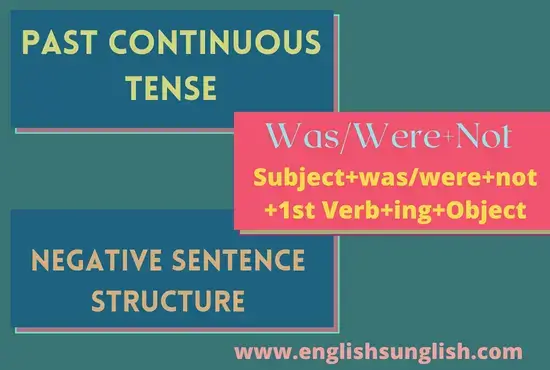
Negative Sentences of Past Continuous Tense use “was not” with singular pronouns and singular number nouns. Negative Sentences of Past Continuous Tense with “was not” has the following Sentence Structure:
I/he/she/it/singular number nouns+ was+ not+ 1st form of Verb+ ing+ Object+ Remaining Words
Negative Sentences of Past Continuous Tense with plural number nouns and plural pronouns as subject use “were not” as a helping verb to show the negativity of the sentence. Negative Sentences with “were not” have the following sentence structure:
You/they/we/plural number nouns+ were+ not+ 1st form of Verb+ ing+ Object+ Remaining Words.
Examples of Negative Sentences of Past Continuous Tense
Following are some examples of Negative Sentences in Past Continuous Tense:
Was+not
“Was not” is used as a helping verb in Past Continuous Tense with singular pronouns and singular number nouns, and has the following sentence structure:
Subject+ was+ not+ 1st form of Verb+ ing+ Object+ Remaining Words.
- The teacher was not teaching us English.
- I was not going on foot.
- The Government was not releasing him.
- The merchant was not coming back home.
- I was not copying from the book.
- Aslam was not playing cricket.
- The servant was not dusting furniture.
- I was not joking with you.
- The water level was not rising.
- I was not sewing her shirt.
- The waterman was not sprinkling water.
- The driver was not driving the car fast.
- The enemy was not crossing the river.
- I was not recommending him for a job.
- He was not beating his brother.
- The servant was not making excuses.
- The peon was not ringing the bell.
- The rich man was not giving alms to the poor.
- The boy was not solving the sum.
- The teacher was not teaching us English.
- I was not going on foot.
- The Government was not releasing him.
- The merchant was not coming back home.
- The bus was not coming that way.
- She was not facing the danger bravely.
- He was not driving the car fast.
- He was not leading the procession.
- The Governor was not presiding over the meeting.
- David was not going to his home.
- The peon was not ringing the bell.
- I was not taking much interest in winning 1st prize.
- I was not chasing her.
Were+not
Plural number nouns and plural pronouns as the subject in Negative Sentences of Past Continuous Tense use “were not” as a helping verb to show the negativity of the action.
Subject+ were+ not+ 1st form of Verb+ ing+ Object+ Remaining Words.
- We were not traveling together.
- They were not making false promises.
- They were not swimming across the river.
- The boys were not singing songs.
- The farmers were not harvesting crops in March.
- The students were not rowing.
- Many students were not taking part in the debate.
- We were not traveling together.
- They were not making false promises.
- They were not swimming across the river.
- People were not taking much interest in attending that function.
- We were not waiting for anyone.
- The dogs were not fighting over the bone.
- We were not dividing the property.
- You were not cooperating with your friends.
- We were not smelling flowers.
- you were not doing your work.
- We were not reading the book.
- They were not plucking the flowers.
Interrogative Sentence Structure of Past Continuous Tense
Interrogative Sentences of Past Continuous Tense with Word of Question take “was/were” after them, and have the following subject, verb, and object agreement:
Word of Question+ was/were+ Subject+ 1st form of Verb+ ing+ Object+ Remaining Words+?
“Was” comes at the start of Interrogative Sentences that have singular number nouns and singular pronouns. Interrogative Sentences of Past Continuous Tense with “Was” at the start have the following Sentence Structure:
Was+ I/he/she/it/singular number nouns+ 1st form of Verb+ing+ Object+ Remaining Words+?
“Were” comes at the start of Interrogative Sentences that have plural number nouns and plural pronouns. Interrogative Sentences of Past Continuous Tense with “Were” at the start have the following Sentence Structure:
Were+ You/they/we/plural number nouns+ 1st form of Verb+ ing+ Object+ Remaining Words+?

Examples of Interrogative Sentences of Past Continuous Tense
Following are some examples of Interrogative Sentences of Past Continuous Tense:
Word of Question+ was/were+?
Interrogative Sentences of Past Continuous Tense with Word of Question take “was/were” after them and have the following Sentence Structure:
Word of Question+ was/were+ Subject+ 1st form of Verb+ ing+ Object+ Remaining Words+ ?
- Why were they walking on foot?
- Where were you roaming about?
- When was I looking at the sky?
- How was he making a picture?
- Who was asking about you?
- When were they passing through the forest?
- Where was the lion drinking water?
- To Whom was your brother writing the letter?
- Who was garlanding the honorable guests?
- Whose socks were they darning?
- Why were the boys quarreling among themselves?
- In which bank were they depositing money?
- Where was the lion roaring in the morning?
- How many men were gathering in the garden?
- Who was throwing stones at the bus?
- Where was the doctor examining the patient?
- Who was repairing your house?
- Why were the police dispersing the processing?
- Who were the people waiting for?
- When were the laborers completing the work?
- Where were the people dancing?
- Why was the plane landing here?
- How many persons considered this matter?
- How many people were sharing this business?
- Who was knocking at the door?
- Which magazine were you reading?
Was+?
“Was” is used in Interrogative Sentences of Past Continuous Tense to ask questions with singular number nouns and singular pronouns. Interrogative Sentences with “was” has the following sentence structure:
Was+ Subject+ 1st form of Verb+ ing+ Object+ Remaining Words+?
- Was he taking part in the games?
- Was the poor girl crying?
- Was the baby sleeping?
- Was she going to her Uncle’s house?
- Was his watch losing ten minutes daily?
- Was the moon appear?
- Was the shopkeeper overcharging the customer?
- Was I writing a letter to your mother?
- Was I going to the hospital?
- Was the tailor sewing my clothes?
- Was it thundering?
- Was the shopkeeper overcharging the customer?
- Was I dozing in class?
- Was he ringing the bell?
- Was the farmer plowing in the fields?
- Was he telling a lie?
Were+?
“Were” is used in Interrogative Sentences of Past Continuous Tense to ask questions with Plural number nouns and plural pronouns. Interrogative Sentences with “was” has the following sentence structure:
Were+ Subject+ 1st form of Verb+ ing+ Object+ Remaining Words+?
- Were you shivering with cold?
- Were the travelers riding on horses?
- Were they making the city beautiful?
- Were both the players running after the ball?
- Were you combing your hair?
- Were they lighting the fire?
- Were they listening to their teacher attentively?
- Were the people reaching the station hurriedly?
- Were they listening to the news?
- Were the players playing football?
- Where are the bad boys throwing stones at buses?
- Were the laborers digging soil?
- Were we playing?
- Were they working on this project?
- Were they learning their lesson by heart?
- Were they plucking the flowers?
- Were you giving him your address?
- Were they criticizing my opinion?
- Were the laborers shirking their work?
- Were we smelling followers in the garden?
- Were the boys dozing in the class?
- Were they serving orange juice to their guests?
Negative-Interrogative Sentence Structure of Past Continuous Tense
Negative-Interrogative Sentences of Past Continuous Tense with Word of Question take “was/were” after them, and “not” after the subject of the Negative-Interrogative Sentences to show the negativity of sentences. Negative-Interrogative Sentences of Past Continuous Tense have the following subject, verb, and object agreement:
Word of Question+ was/were+ Subject+ not+ 1st form of Verb+ ing+ Object+ Remaining Words+?
“Was” comes at the start of the Negative Interrogative Sentences of Past Continuous tense and “not” comes after the subject to show the negativity of the sentence. “Was” is used for such actions that have singular number nouns and singular pronouns as the subject. Negative-Interrogative Sentences of Past Continuous Tense with “Was” at the start have the following Sentence Structure:
Was+ I/he/she/it/singular number nouns+ not+ 1st form of Verb+ing+ Object+ Remaining Words+?
“Were” comes at the start of the Negative-Interrogative Sentences that have plural number nouns and plural pronouns, and “not” comes after the subject of the sentence. Negative-Interrogative Sentences of Past Continuous Tense with “were” at the start, have the following Sentence Structure:
Were+ You/they/we/plural number nouns+ not+ 1st form of Verb+ ing+ Object+ Remaining Words+?

Examples of Negative-Interrogative Sentences of Past Continuous Tense
Following are some examples of Negative-Interrogative Sentences of Past Continuous Tense:
Word of Question+ was/were+ Not+?
Negative-Interrogative Sentences of Past Continuous Tense having Word of question use “was/were” after the Word of Question, and “not” comes after the subject of the sentence. Negative-Interrogative Sentences of Past Continuous Tense with Word of Question have the following Sentence Structure:
Word of Question+ was/were+ Subject+ not+ 1st form of Verb+ ing+ Object+ Remaining Words+?
- Why were they not walking on foot?
- When were you not roaming about?
- Why was I not looking at the sky?
- Why was he not making a picture?
- Who was not asking about you?
- When were they not passing through the forest?
- Why was the lion not drinking water?
- Why was your brother not writing the letter to your mother?
- Why were they not garlanding the honorable guests?
- Whose socks were they not darning?
- Why were the boys not quarreling among themselves?
- In which bank were they not depositing money?
- Why was the lion not roaring in the morning?
- How many men were not attending that event?
- Who was not throwing stones at the bus?
- Why was the doctor not examine the patient?
- Why was your house not repaired? (Passive Voice)
- Why were the police not dispersing the processing?
- Why were the people not waiting for their reward?
- When were the laborers not completing the work?
- Why were the people not dancing?
- Why was the plane not landing here?
- How many persons were not considered in this matter?
- How many people were not sharing this business?
- Who was not knocking at the door?
- Which magazine were you not reading?
Was+Not+?
Negative-Interrogative Sentences with singular number nouns and singular pronouns, use “was” at the start of the Sentence, and has the following sentence structure:
Was+ Subject+ not+ 1st form of Verb+ ing+ Object+ Remaining Words+?
- Was he not taking part in the games?
- Was the poor girl not crying?
- Was the baby not sleeping?
- Was she not going to her Uncle’s house?
- Was his watch not losing ten minutes daily?
- Was the moon not appear?
- Was the shopkeeper not overcharging the customer?
- Was I not writing a letter to your mother?
- Was I not going to the hospital?
- Was the tailor not sewing my clothes?
- Was it not thundering?
- Was the shopkeeper not overcharging the customer?
- Was I not dozing in class?
- Was he not ringing the bell?
- Was the farmer not plowing in the fields?
- Was he not telling a lie?
Were+Not+?
Negative-Interrogative Sentences with plural number nouns and singular pronouns, use “were” at the start of the Sentence, and has the following sentence structure:
Were+ Subject+ not+ 1st form of Verb+ ing+ Object+ Remaining Words+?
- Were you not shivering with cold?
- Were the travelers not riding on horses?
- Were they not making the city beautiful?
- Were both the players not running after the ball?
- Were you not combing your hair?
- Were they not lighting the fire?
- Were they not listening to their teacher attentively?
- Were the people not reaching the station hurriedly?
- Were they not listening to the news?
- Were the players not playing football?
- Were the bad boys not throwing stones at buses?
- Were the laborers not digging soil?
- Were we not playing?
- Were they not working on this project?
- Were they not learning their lesson by heart?
- Were they not plucking the flowers?
- Were you not giving him your address?
- Were they not criticizing my opinion?
- Were the laborers not shirking their work?
- Were we not smelling followers in the garden?
- Were the boys not dozing in the class?
- Were they not serving orange juice to their guests?
Past Continuous Tense-Passive Voice:
Passive Voice of Past Continuous Tense can be made by following the rules mentioned in the following: