Currier vs. Courier: Which Spelling Is Correct?
Currier vs. Courier: Which One Do You Actually Need?
You typed “currier service near me” and Google understood you anyway. Search engines are forgiving like that. A client reading your shipping page is not — and neither is a hiring manager scanning your CV.
Here’s the short version.
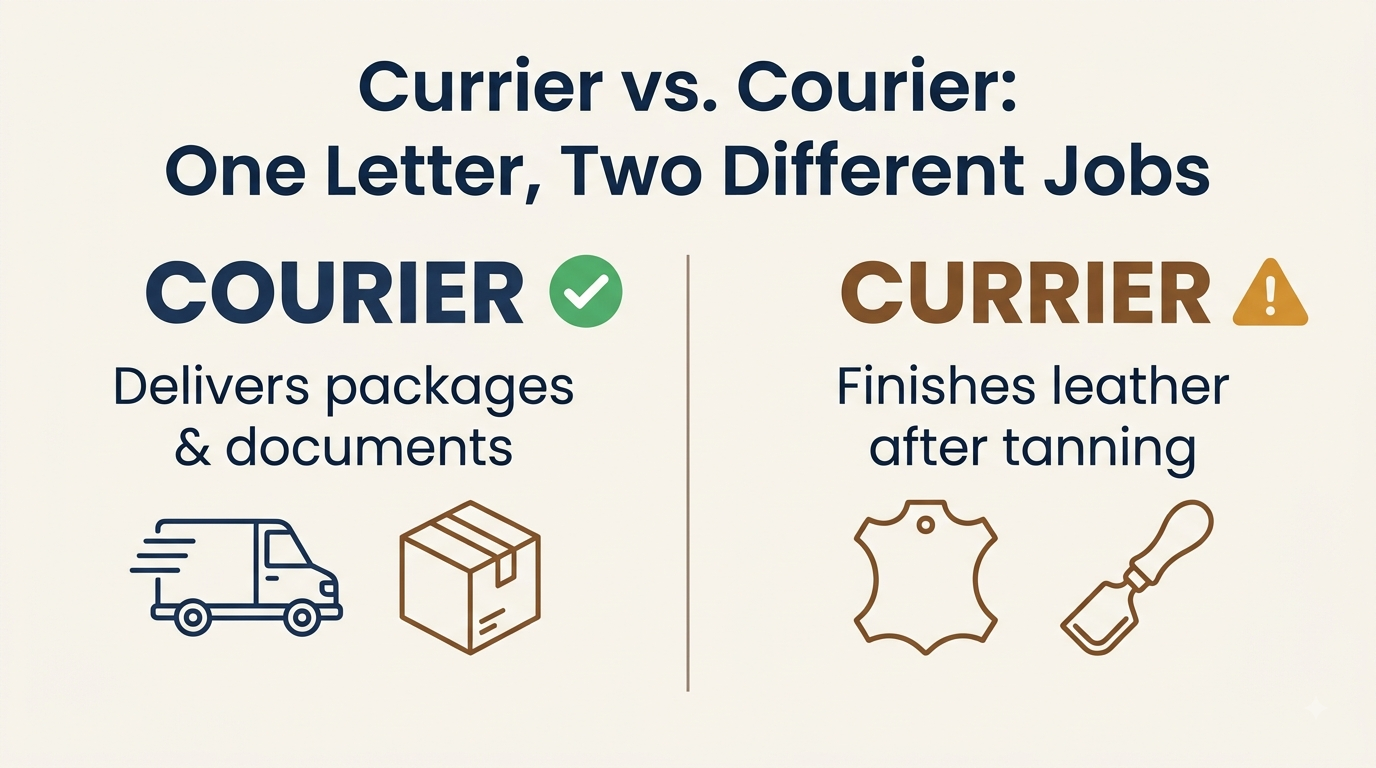
Quick answer: currier vs courier spelling? In almost every modern sentence, courier is the word you want. A courier is a person or company that delivers packages, documents, and messages. A currier is a leatherworker who softens and finishes hides after tanning. Both are real English words. Only one of them has anything to do with delivery.
That’s the whole rule. Everything below is why the currier or courier mix-up happens, and how to stop making it.

Currier vs. Courier at a Glance
| Courier | Currier | |
|---|---|---|
| Meaning | A person or company that delivers packages, documents, or messages | A skilled worker who softens, oils, and finishes leather after tanning |
| Word origin | Latin currere, “to run” | Latin corium, “hide” or “leather” |
| How common? | Everyday word | Rare; mostly historical or a surname |
| Field | Logistics, shipping, business | Leatherwork, historical trades |
| Used as a verb? | Yes — couriered, couriering | No |
| Example | The courier arrived before nine. | The currier softened the hide for weeks. |
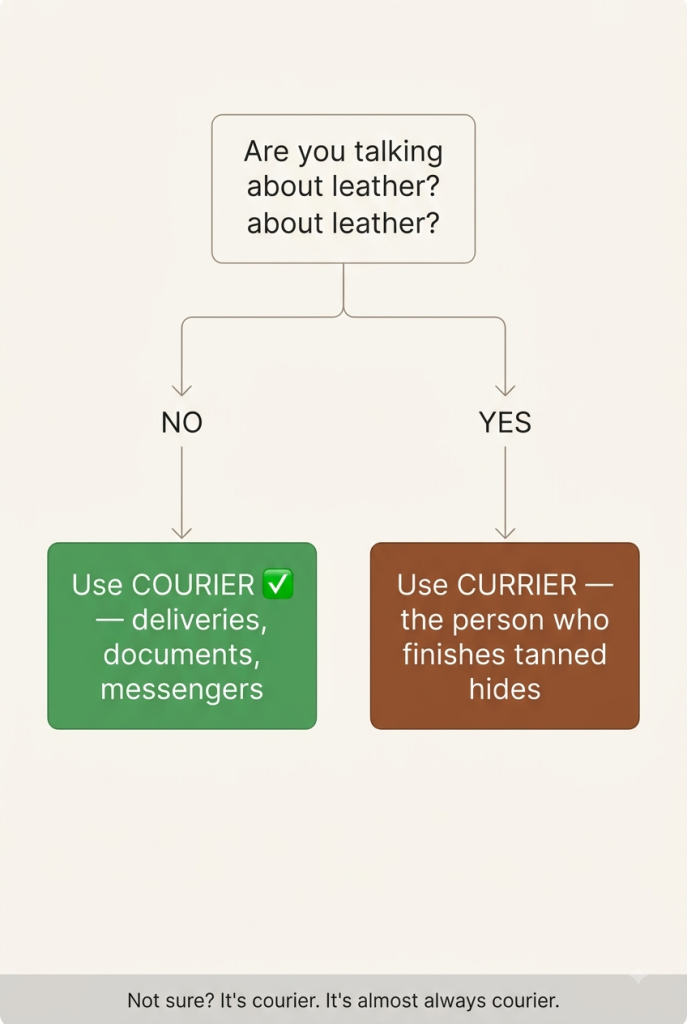
| If you’re unsure | ✅ This is almost certainly your word | ❌ Only if you mean leather |
What Does Courier Mean?
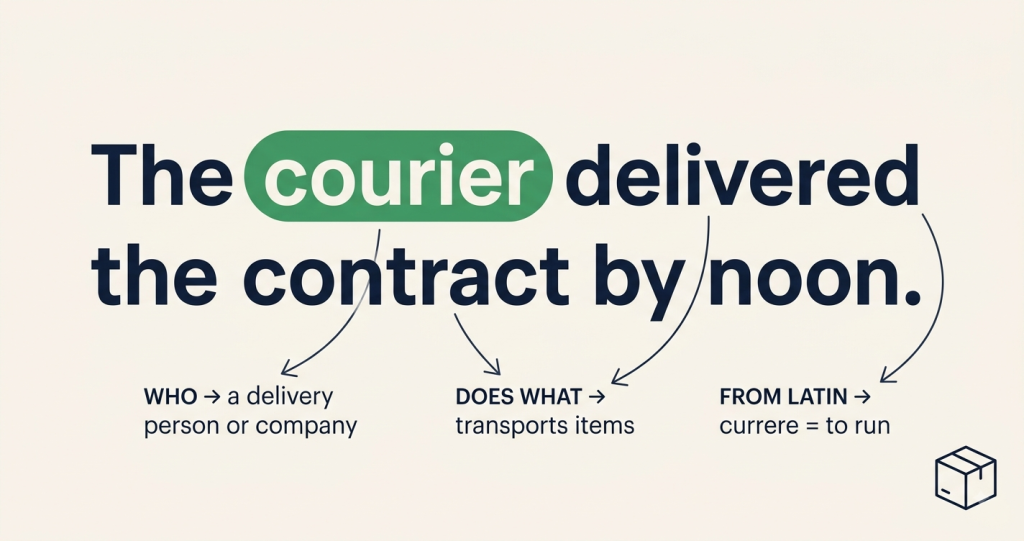
A courier meaning delivers things. Documents, parcels, sensitive contracts, a passport that needs to reach an embassy by Friday — a courier moves them from one place to another, usually fast and usually tracked.
The word can refer to a person or to an entire company. DHL is a courier. So is the man on the motorbike who brings you your parcel.
✅ Correct: The courier signed for the package at reception.
❌ Incorrect: The currier signed for the package at reception. Why: The person at reception is delivering a parcel, not finishing leather.
The origin explains the meaning better than any definition does. Courier comes through Old French and Italian from the Latin verb currere, meaning “to run.” Early couriers literally ran messages across distances. The running stopped. The name stayed.
British English adds one extra meaning most learners never meet: a courier can also be a tour guide who travels with a holiday group. You’ll see this in UK job listings and travel writing.
✅ Correct (British usage): Our courier met the coach at Gatwick and handled the hotel check-in.
Courier used as a verb
You can courier something. Collins lists the forms couriered and couriering, so this isn’t slang — it’s standard, especially in British and Commonwealth business English.
✅ Correct: We couriered the signed contract to Dubai overnight.
✅ Also correct: We sent the signed contract by courier. Why: Both work. The verb form is more compact; the noun form is safer in very formal writing.
What Does Currier Mean?
A currier meaning finishes leather. After a tanner has treated a hide, the currier takes over: stretching it, oiling it, shaving it to an even thickness, and working it until it’s supple enough for boots, saddles, or belts. It’s a real craft with real technical skill behind it.
The trade is mostly gone. Machines handle leather finishing now, and the word survives mainly in historical writing, in guild names, and in family names. In London, the Worshipful Company of Curriers still exists as a livery company — a fossil of the old trade.
✅ Correct: The currier worked the hide until it was soft enough to stitch.
❌ Incorrect: I’m waiting for the currier to bring my parcel. Why: Parcels aren’t leather. Unless your delivery driver moonlights in a tannery, you mean courier.
Here’s a detail worth keeping: curry — as in a currycomb for grooming a horse, and in the phrase curry favour — comes from the same leatherworking root. It has nothing to do with the food. Two separate words that happen to look identical in English.
Why These Two Words Get Confused So Often
Two reasons, and neither is carelessness. Build your English vocabulary the practical way.
They can be true homophones
In Received Pronunciation, courier starts with the vowel in put — roughly KOOR-ee-uh. Currier starts with the vowel in cut — KURR-ee-uh. Different sounds, so British speakers usually hear the gap.
General American often collapses that difference. Because of a vowel merger that affects words like hurry and furry, many American speakers pronounce courier and currier identically. If two words sound exactly the same and differ by one letter, misspelling one as the other isn’t a mistake. It’s inevitable.
That’s the part almost every article on this topic leaves out, and it’s the real explanation.
Spellcheck won’t save you
Courier vs Carrier? Type couriar and your editor underlines it instantly. Type currier and nothing happens — because currier is a legitimate dictionary word. Word, Gmail, Docs, and most grammar checkers see a valid noun and move on.
Which means the error survives all the way to a published page, a printed invoice, or a job application. Nobody catches it until a reader does.
Where You’ll Actually See the Word Currier
If currier is so rare, why does it feel familiar? Because you’ve almost certainly encountered it in three places that have nothing to do with delivery.
As a surname. Currier is an occupational last name, handed down from ancestors in the leather trade — the same way Smith, Cooper, and Baker came about.
Currier & Ives. The 19th-century American printmaking firm founded by Nathaniel Currier produced thousands of lithographs of winter scenes, city life, and rural America. The phrase “a Currier and Ives Christmas” is still in circulation. That’s a family name on a business, not a word about leather or parcels.
Courier New. The typewriter-style font bundled with almost every computer is spelled Courier — no U-R-R. People who half-remember the font name are a large share of everyone typing “currier.”
None of these three is a delivery service. Recognising them removes most of the doubt.
How to Remember the Difference (Two Tricks That Stick)
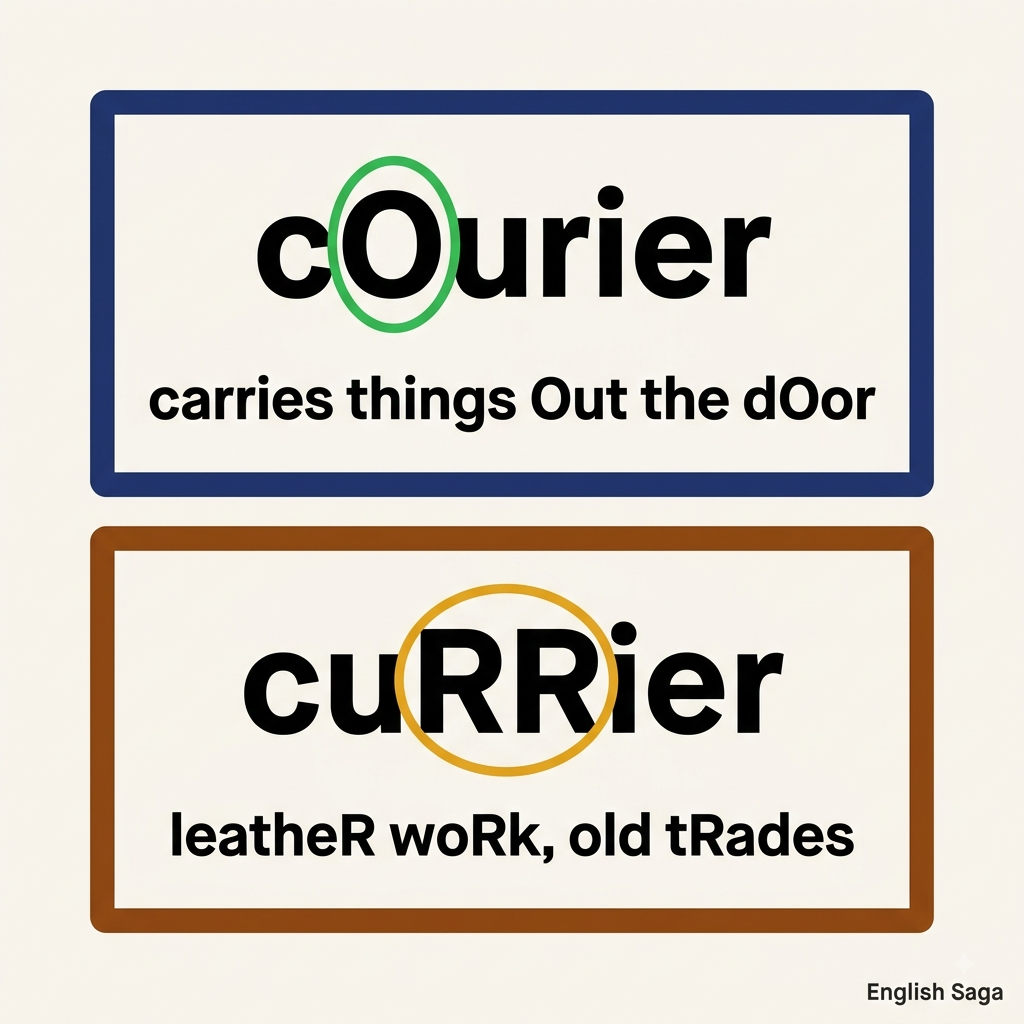
Trick 1 — Follow the O. C-O-urier carries things Out the d-O-Or. The O is the delivery letter. No O in the second syllable? Then you’re in the leather workshop.
Trick 2 — Match the double letters. cu-RR-ier and lea-th-er both belong to the old trades. If your sentence has no hides in it, drop the double R.
Pick one. Two competing tricks are worse than one you actually recall under pressure.
Common Mistakes to Avoid
1. Writing “currier service” on a business page. This is the single most common version of the error, and it appears on real company websites. A reader who notices it starts questioning everything else on the page.
2. Assuming currier is a British spelling. It isn’t. British and American English both spell the delivery word courier. There’s no regional variation here at all.
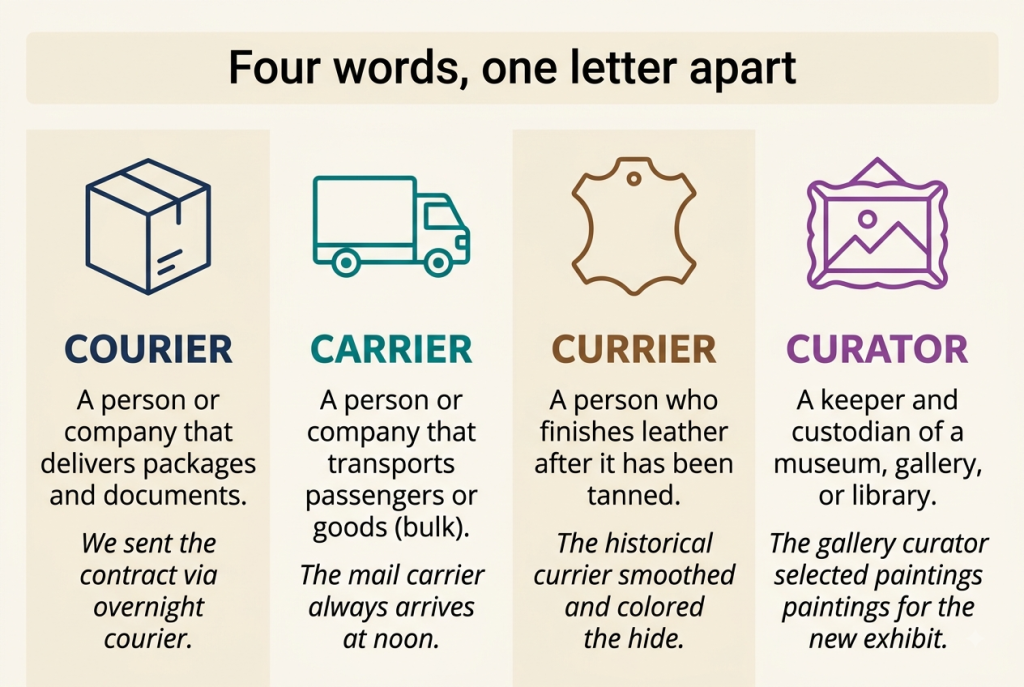
3. Mixing up courier and carrier. These are both delivery words, but they’re not identical. A courier usually handles fast, tracked, door-to-door delivery of smaller items. A carrier is the broader term for a company that transports freight and mail at scale. Overlapping, not interchangeable.
4. Reading historical texts wrongly. In an 18th- or 19th-century document, “the curriers of the town” means leatherworkers, not messengers. Easy to misread if you’re skimming.
5. Trusting autocorrect. Covered above, worth repeating: your software will not flag this one.
Courier vs. Carrier vs. Currier: Quick Reference
| Word | It means | Use it when | Sample sentence |
|---|---|---|---|
| Courier | Delivers documents and parcels quickly | You’re talking about deliveries, messengers, or shipping | Send it by courier — it needs to arrive tomorrow. |
| Carrier | Transports goods, freight, or mail at scale | You mean a large transport or shipping company | The carrier handles our bulk freight. |
| Currier | Finishes and softens tanned leather | You’re writing about leatherwork or history | The currier prepared hides for the saddle maker. |
| Curator | Looks after a collection | You mean museums, galleries, or archives | The curator arranged the exhibition. |
Practice: Test Yourself
Choose the correct word for each sentence.
- The ________ delivered the passports to the embassy before closing.
- In the 1800s, a ________ would spend days softening a single hide.
- Our shipping page had a typo — it said “________ service” for two years.
- Nathaniel ________ founded a famous American printmaking firm.
- She ________ the documents to Karachi overnight.
Answer key
- courier — passports being delivered
- currier — leather being softened
- currier — the typo itself; the correct word is courier
- Currier — a surname, capitalised
- couriered — the verb form of courier
Scored five out of five? You’re done with this word for good.
Frequently Asked Questions
is currier a word or just a misspelling of courier? It’s a real word with its own entry in major dictionaries. A currier is a leatherworker who softens and finishes hides after tanning. That said, when someone types currier today, they’ve almost always misspelled courier — the delivery word.
How do you pronounce courier correctly? In British English, it begins with the vowel sound in put: KOOR-ee-uh. In General American, it’s often pronounced with the vowel in cut, making it sound the same as currier. Both American pronunciations are widely accepted, so pick one and stay consistent.
Is it “courier service” or “currier service”? It’s courier service, always. This is the most common place the error shows up — on business websites, invoices, and contact pages. If your page currently reads “currier service,” fix it before your next customer reads it.
Can courier be used as a verb? Yes. Couriered and couriering are listed as standard verb forms, and they’re common in British and Commonwealth business English. “We couriered the contract” is correct. In very formal writing, “we sent the contract by courier” reads a little safer.
What’s the difference between a courier and a carrier? A courier typically handles fast, tracked, door-to-door delivery of documents and smaller parcels. A carrier is the broader term for companies transporting freight, mail, and cargo at scale. Many businesses use both, for different kinds of shipments.
Why is it spelled Currier in “Currier & Ives”? Because that’s a surname, not a vocabulary word. Nathaniel Currier co-founded the 19th-century American print firm, and Currier is an occupational last name inherited from ancestors in the leather trade — much like Smith or Cooper.
About the Author
Christopher has taught English grammar and vocabulary for 10 years, working with ESL students and business professionals. This guide comes from the confusions that show up in real student writing, not from a dictionary summary.
Sources: Oxford Learner’s Dictionaries — courier · Collins Dictionary — courier pronunciation and verb forms.